Private citizens have flown above the Kármán line, orbited the poles and walked in space. Here is what the new era of space tourism makes possible for travelers.
For most of history, space was the one destination no traveler could reach. That has changed in a single decade. Private citizens have now flown above the boundary of space, circled the poles in orbit and stepped outside a spacecraft on a commercial spacewalk.
For lovers of extraordinary travel, this is the most thrilling frontier of all. And even for those who stay on the ground, space tourism is creating new ways to experience the wonder of launch, the night sky and the story of exploration.
A Decade of Firsts
The pace of progress has been remarkable. In only a few years, private spaceflight moved from concept to a steady rhythm of missions, each one expanding who can go and what they can do.
- September 2021: SpaceX's Inspiration4 flew an all-private crew to orbit and raised $250 million for St. Jude Children's Research Hospital.
- 2021 onward: Blue Origin's New Shepard began carrying people on suborbital flights, with six astronauts aboard from its third crewed mission.
- September 2024: SpaceX's Polaris Dawn mission carried out history's first commercial spacewalk.
- Spring 2025: SpaceX's Fram2 became the first human spaceflight to orbit over Earth's poles.
The Companies Making It Possible
Blue Origin: Above the Kármán Line
Blue Origin's New Shepard was designed for one beautiful purpose: to carry passengers above the Kármán line, the commonly used boundary of space, for several minutes of weightlessness and a view of Earth against the blackness of space.
The program flew its 14th numbered crewed mission in August 2025. By October 2025, New Shepard had carried 86 people to space, representing 80 individual astronauts, according to reporting on its 36th flight. In December 2025, the NS-37 mission carried a wheelchair user above the Kármán line, a moving milestone for accessibility in spaceflight.
The flights have welcomed a wide range of people: entrepreneurs, educators, scientists and dreamers who simply wanted to see the planet whole. Each crew member returns with the same report, a renewed sense of how fragile and beautiful Earth looks from above.
SpaceX: Orbit, Spacewalks and the Poles
SpaceX has taken private travelers further than anyone. Its Crew Dragon spacecraft carries crews to orbit, where missions last days rather than minutes.
On September 10, 2024, Polaris Dawn launched from Kennedy Space Center's historic Launch Complex 39A. The mission planned to raise its orbit to about 870 miles (1,400 kilometers) and then carried out the first commercial spacewalk, with commander Jared Isaacman and Sarah Gillis stepping out of the capsule one at a time.
In spring 2025, Fram2 opened another new chapter. The mission, which lifted off on March 31 (Eastern Time), flew a polar orbit, a path no human spaceflight had taken before. Its four crew members, all first-time flyers from four different nations, were led by mission commander Chun Wang of Malta, with Jannicke Mikkelsen of Norway as vehicle commander. The crew grew mushrooms in orbit and took the first X-rays of the human body in space. It was SpaceX's 17th human spaceflight and its sixth for private customers.
The View That Changes Everyone
Astronauts often describe a shift in perspective when they first see Earth from space: the thin blue line of the atmosphere, the absence of borders, the planet suspended in darkness. Writers have called it the overview effect, and private flyers report it just as vividly as career astronauts.
That is the true luxury of space travel. It is not the hardware or the headlines but a moment of clarity that travelers carry home for the rest of their lives. Many return with a new commitment to family, community or the planet itself.
Suborbital and orbital flights offer two distinct versions of that experience:
- Suborbital flights, like New Shepard, deliver a short, intense journey with minutes of weightlessness and a sweeping view of the curve of the Earth.
- Orbital missions, like those on Crew Dragon, last for days, with sunrises and sunsets every orbit and time to settle into life in space.
Who Is Flying
One of the most encouraging trends is the diversity of the people taking part. Recent crews have included first-time flyers from many nations, educators, researchers, adventurers and advocates for accessibility. Fram2 alone brought together four rookies from four countries.
Each mission widens the circle. Training programs prepare private crews thoroughly, and operators have shown that a deep sense of curiosity matters as much as any professional background.
What Space Tourism Offers Travelers Today
Space tourism is not only for those who fly. It has created a rich set of experiences for curious travelers on the ground:
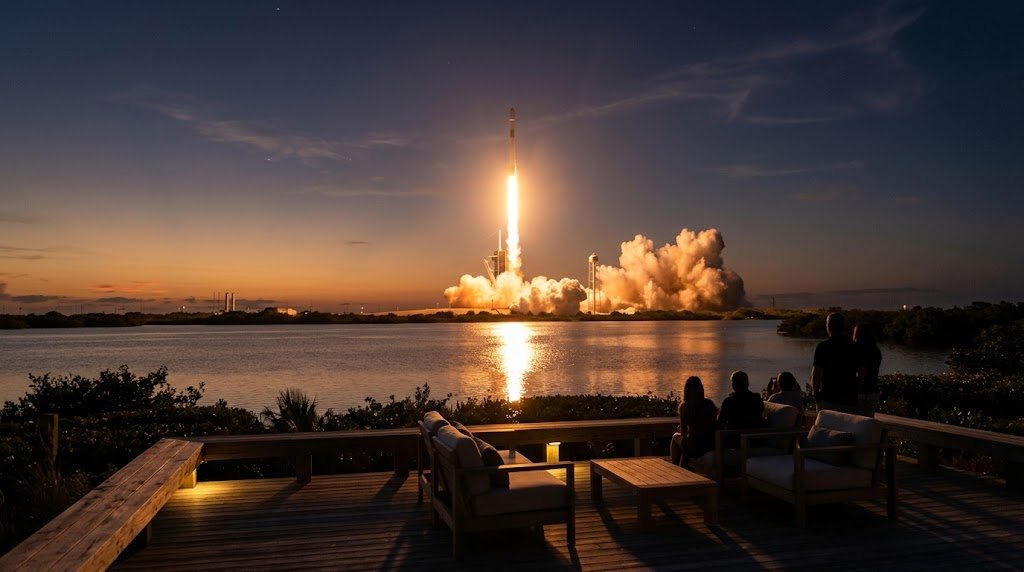
- Launch viewing: Florida's Space Coast, home to Kennedy Space Center, has become a destination for watching rockets rise at dawn or after dark.
- Space centers and museums: Visitor complexes let guests stand beside historic spacecraft and meet the people who build them.
- Astro-tourism: Dark-sky lodges and observatories, from the deserts of Chile to the American Southwest, turn the night sky into the main attraction.
- Training experiences: Zero-gravity flights and astronaut-style programs offer a taste of weightlessness without leaving the atmosphere.
Timing a trip around a launch takes a little flexibility, since schedules can shift with weather and technical checks. The reward is worth it: the light of a night launch can illuminate the whole coastline, and the sound arrives moments later as a deep, rolling thunder you feel as much as hear.
Combined with a luxury stay, a launch or a night under exceptional stars can become the centerpiece of a truly original trip.
Where the Journey Goes Next
The momentum points toward more people, more mission types and more ways to take part. Private crews are flying science experiments, raising money for causes and carrying cameras that share the view with millions at home. Each mission makes the next one feel a little more familiar.
For the luxury traveler, this evolution echoes the early days of jet travel and polar cruising. Experiences that once belonged to a handful of pioneers became, step by step, journeys that curious people could plan, anticipate and share. Space appears to be following the same graceful arc, with each successful mission adding confidence and new possibilities.
The deeper story is one of access. Space is gradually becoming a place where ordinary dreams can come true, carried by engineers and explorers who believe the view from orbit should be shared widely.
Dreaming bigger than the sky
If spaceflight is on your list, follow the operators closely and register interest early, since seats on each mission are few. If your ambitions are earthbound for now, plan a trip around a launch on the Space Coast or a few nights at a dark-sky retreat.
Either way, this is a remarkable time to be a traveler. The final frontier has become a destination, and its story is still being written.
Sources
- Blue Origin, "Human Flight" mission archive, accessed October 2026.
- Blue Origin, "New Shepard NS-36 Mission," October 8, 2025.
- Scientific American, "Polaris Dawn Astronauts Launch on Daring Private Mission," September 10, 2024.
- Scientific American, "Watch SpaceX Launch Historic Fram2 Crewed Mission over Earth's Poles Tonight," March 31, 2025.
- Megaproject, "SpaceX Wraps Up Sixth Private Astronaut Mission," April 11, 2025.